
Module 2: How to understand ecological health
Featuring:
Hannah Yu-Pearson
Centric Lab

In this lesson we speak to Hannah Yu-Pearson, part of the Centric Lab team, on epistemologies, language, power and health justice.
She shares insights on the ways in which the words we use shape the experiences that we have, and how to use language as a way to open up more imaginings and more justice pathways.
Key Learnings: Definitions
-
Discourse analysis is a method of studying the construction of meaning, power and social reality through language.
-
Epistemology is the study of knowledge. It seeks to understand the origins, creation and nature of knowledge, and how particular knowledges then shape our understanding of ourselves and the world, and therefore our behaviours, actions and what we take to be true.
-
A linguistic tool to convey meaning to potentially abstract words, it is when a word or phrase literally denoting one kind of object is used in place of another to suggest likeness, symbolism or representation.
For example, ‘time is money’, this uses the concept of commodity to help make sense and assign value to time which is abstract, more subtle uses of this metaphor would be ‘investing time’, ‘run out of time’.
Another example would be ‘battling cancer’ or ‘fighting off a cold’ . This type of language denotes war and is used to construct meaning around the experience of illness. Illness in itself is not a battle, it is simply portrayed as one.
-
The creation of a noun (naming word) out of a verb (doing word), e.g. the noun pollution out of the verb to pollute.
-
Passive voice is a grammatical structure that creates an indirect expression where more attention is placed on the object (receiver of the action) than the subject (performer of the action). ‘The air has been polluted’ uses passive voice, it does not include who or what did the action. The active voice would include the subject and read ‘X has polluted the air’.
Key Learnings: Our Thoughts
Epistemologies - ways of knowing - are historically and culturally constructed, laden with power structures. The study of epistemology is the study of how knowledge shapes our understanding of ourselves and the world, and therefore our behaviours and actions. Everything we do in society is based on ways of knowing - policy, healthcare, our takes on reality - therefore expanding our ways of knowing, e.g. the knowledges we engage with and contribute to, will expand our options.
Language is the cornerstone of cognition, It provides the ability to form meanings and theories about the phenomena that we experience.
Discourse analysis is the study of the construction of meaning and power through language. There is power in discourse, e.g. how we choose to use language to convey meaning, and there is power behind discourse, the legitimacy given to those choosing the language (e.g. author or funder).
One discursive tool is metaphor - we use metaphor to collapse separate things and meanings into one to help convey our intention. E.g. ‘time is running out’, this phrase has hidden within it the assignment of monetary/commodity value.
Nature in the western context is often associated with resource and capital, e.g. ‘natural resources’, ‘biodiversity net gain’ this then denotes wealth creation and extraction of nature. These resource metaphors hide all sorts of possible conceptions that exist in other cultures, for example kinship in the use of ‘Air is kin’ for this project. This relational metaphor and conception shows a reciprocity with Air that resource metaphors do not allow for.
The choice of grammar contains multiple discursive tools. Firstly, nominalisation is a subtle form of legitimation used to hide causality and subjectivity. Nominilisation rests on assumptions of shared understanding, e.g. pollution, discrimination. The processes involved with these words as verbs (to pollute, to discriminate) are removed, removing with them the agents and affected. When we use verbs, we tend to name who is completing the action and who is receiving it. Similarly, the passive voice removes the subject (the do-er) and therefore their agency, and for our interests, their accountability. ‘Pollution’ is therefore constructed as a natural phenomena where who or whatever responsible for it is erased.
Bringing more awareness to the language we consume and use in our campaigns opens up many more avenues of understanding, knowing and therefore being.
The power in community led research and community campaigns is the expansion of definitions, framings and what is classified as data and evidence. These efforts are subversive in their challenge to and divestment from knowledge supremacy.
Language can be nonverbal too. How can we listen to the language of our bodies through sensation? For example, what does tension communicate?
What in this lesson stood out for you?
Debate Questions
These questions are framed to help you apply your own experience and perspectives to points raised in this lesson.
Take a look at a news report of your area or campaign and identify the ways that language has been used to distort meaning or reality, why do you think that happened?
What are the most common metaphors around that could use some questioning or rewriting to change the way you approach the matter? E.g. moving from ‘food desert’ to ‘food apartheid’, naming it apartheid shows that it is a process and an injustice, rather than a natural occurrence.
Are there ways that language fails to capture your experience? Explore other non-verbal or written ways to communicate what is happening and how it is being experienced. E.g. through art, music, movement.

How To…
Be critical with the language we use in movements and campaigns
In this Oxford English dictionary definition -
The presence in or introduction into the environment of a substance which has harmful or poisonous effects. "the level of pollution in the air is rising"
Identify where the agent and affected have been invisibilised, and re-write the sentence in a way that names perpetrator of pollution and victim of it.
Consider other documents or news articles that successfully hide the industrial polluters and the decision makers that make contamination possible. Rewrite them so that those causing harm can be named, and therefore made accountable.
For example -
“Air pollution is an invisible danger - and we’re using data to help fight it” – NHS Digital
This headline anthropomorphises air pollution as its own actor independent of the processes and entities that do the polluting, data has been identified as a way to fight ‘it’, without acknowledging that the polluters will continue contaminating despite this fight.
In your own advocacy materials, consider how you are using language that may be alienating to your community or your audience as a result of using words that carry many assumptions and ambiguities. Ensure your materials are as direct as possible, including definitions, and naming processes that have become naturalised. Us the following as a point of reference and get a fresh set of eyes to review important materials:
Anthropomorphisation of outcomes and impacts that hide the key causes of harm.
Socially or culturally alienating terminology.
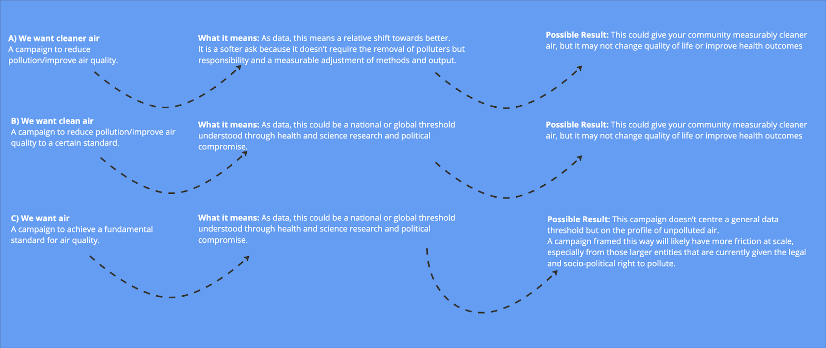
Misaligned or misleading semantics. For example, the difference between advocating for “clean air”, “cleaner air”, and “air” (as pictured in the image below).
Next Lesson:
Module 2 Lesson 4